How can we help you today?
myKN
Quote, book and get full control of your shipments.
Get an instant quote
Talk to an expert
We help you to navigate through your logistics questions.
Get in touchmyKN
Quote, book and get full control of your shipments.
Get an instant quote
Talk to an expert
We help you to navigate through your logistics questions.
Get in touchAlign your warehouse network with your customer experience strategy
Where you store inventory, how fast you pick and pack, and how close you are to your customer – these decisions deliver on your brand promise.
Key Takeaways
E-commerce fulfillment is a customer experience function, not a back-office one. Warehousing decisions directly shape delivery speed, accuracy and post-purchase loyalty.
Last-mile delivery accounts for 53% of total shipping costs, making warehouse proximity to the end consumer one of the most powerful cost and speed levers in your network.
Consumer delivery expectations have compressed to two to three days as the new norm, making warehouse network design a competitive differentiator—not just an operational consideration.
Returns management is a fulfillment decision, not a customer service one. 70% of consumers will abandon a brand after just two negative experiences.
What e-commerce fulfillment actually involves
How does it differ from a distribution center?
A traditional distribution center is designed for bulk business-to-business (B2B) shipments. It is positioned near ports or production facilities, with longer dwell times and no emphasis on dispatch speed. E-commerce service level agreements—often same-day or next-day delivery—require a fundamentally different design, location strategy and technology stack. The companies that treat the warehouse purely as a storage cost leave a significant competitive lever untouched.
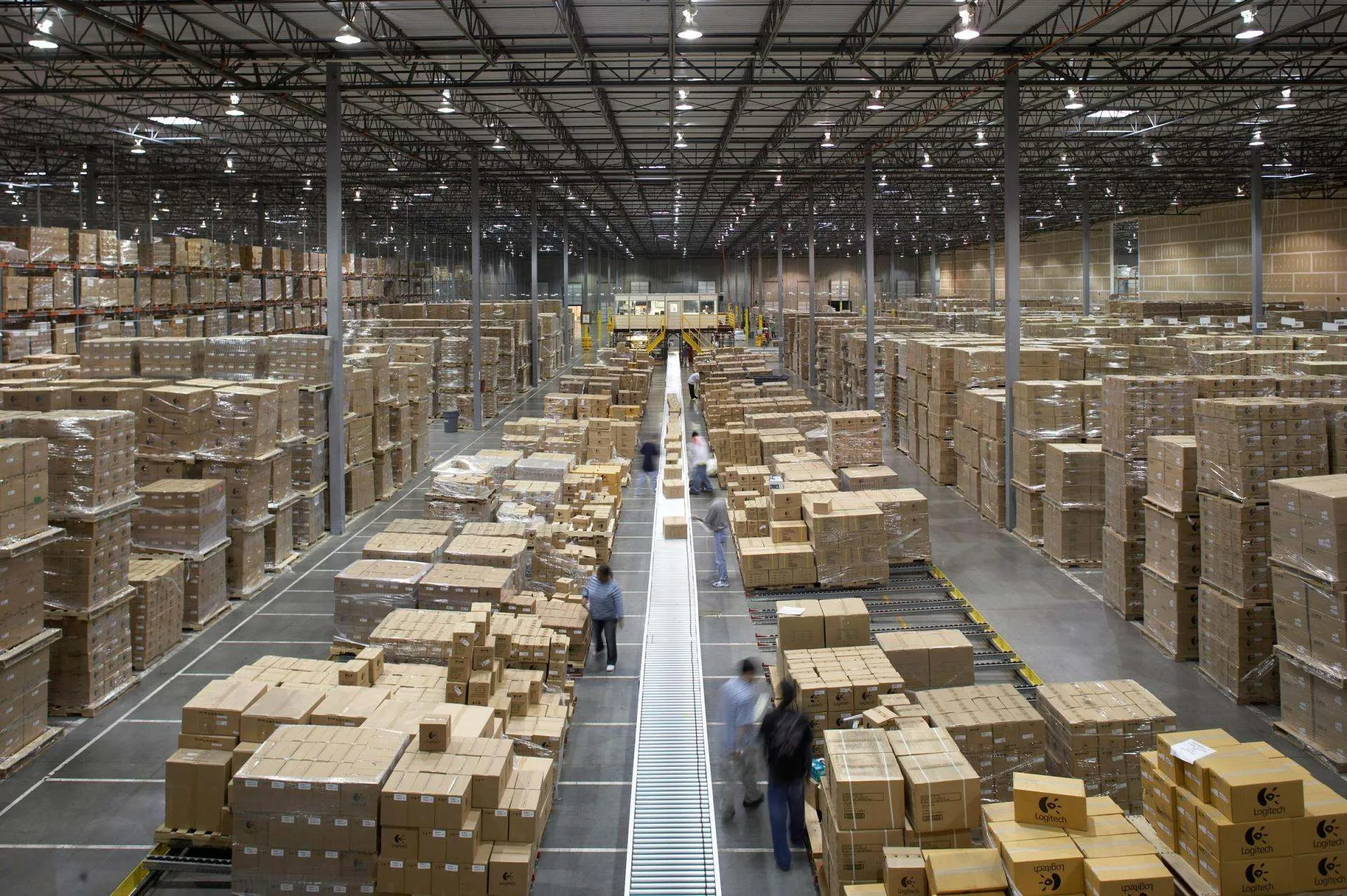
Global e-commerce retail sales are forecast to reach $6.42 trillion in 2025 and $7.89 trillion by 2028—reflecting the scale of fulfillment infrastructure now required to serve digital commerce demand worldwide.
eMarketer, February 2025
Why warehousing decisions directly affect customer loyalty
In e-commerce, the right warehousing decisions are key to success. A fulfillment center positioned too far from the customer means longer last-mile transit, higher carrier costs and delivery windows that miss expectations. Poor returns infrastructure means customers wait days for refunds, eroding trust at the moment it is hardest to recover.
The effect shows up across metrics that matter most: increased customer service costs, rising return rates, declining Net Promoter Scores and, ultimately, lost repeat purchase revenue.
The World Economic Forum's research on the future of consumption confirms the macro context: e-commerce has fundamentally reset consumer expectations, and brands that fall short lose customers permanently.
When delivery speed and accuracy fall below expectations, the impact is immediate. The risk is losing the repeat buyer, absorbing the churn, and paying for it in customer service volume and declining review scores.
More than half of consumers say they stopped using or buying from a brand because of a bad experience with its products or services—making every failed fulfillment commitment a direct path to permanent customer loss.
PwC 2025 Customer Experience Survey
70% of consumers will abandon a brand after just two negative experiences—meaning every failed fulfillment commitment carries a direct and measurable churn cost
Emplifi, 2025
The hidden cost of warehouse network misalignment
Last-mile delivery as a dominant cost driver
Last-mile delivery accounts for 53% of total e-commerce logistics cost, making warehouse proximity to the end consumer one of the most impactful variables in your cost structure. Most of that cost is determined before the parcel leaves the warehouse—by the distance it must travel, the carrier tier required, and the speed commitment behind the order.
Inventory distortion from network positioning
When stock sits too far from demand clusters, or is distributed without reference to regional sell-through data, the result is simultaneous overstock and stockout.
Research estimates the global cost of inventory distortion at $1.7 trillion annually, most of it flowing from misaligned warehouse networks and regional demand forecasting.
Regulatory and cross-border complexity
Cross-border e-commerce requires bonded warehousing, customs-compliant storage and correct returns documentation in every jurisdiction. A warehouse management system (WMS) that provides real-time inventory visibility at SKU level is now a baseline requirement for cross-border fulfillment.
How do you design a fulfillment network around your customer?
Where are your top 20% of orders being delivered? That answer should determine your fulfillment center locations.
Where are there gaps in delivery promises? These are the network gaps to close.
If more than 30% of your orders travel over 500 km to reach the consumer, distributed fulfillment will reduce both cost and transit time.
High-returns categories—fashion, footwear, electronics—require reverse logistics infrastructure built into the network, not retrofitted after scale.
Real-time inventory visibility at SKU level across every location is a prerequisite for distribution fulfillment. Without it, distributed fulfillment creates more problems than it solves.
The best fulfillment network is the one most precisely aligned to where your customers live and how they want to receive and return goods. Most companies design their warehouse networks around internal convenience. Those that consistently win on customer experience design them around external reality.
Best practices for a fulfillment network built around customer experience
Warehouse network design
Use demand heatmapping to identify where your next distribution location should be before you need it - place it where order density already justifies the investment.
Dispatch speed
Set a same-day or next-morning cut-off and build your pick-and-pack operation backward from that commitment. Every process decision - staffing, slotting, carrier handover - should serve it.
Returns management
Co-locate returns processing with outbound fulfillment to reduce cycle time on refunds and replenishment. Separate returns facilities directly damage loyalty in high-returns categories.
Inventory positioning
Use sell-through velocity and regional demand data to place the right SKUs in the right warehouse. A blanket distribution of every SKU across all warehouses inflates carrying cost and obscures true demand patterns.
Technology
Your WMS must provide real-time inventory visibility at SKU level across all locations, with direct integration to your e-commerce platform and carrier network. Without that integration, distributed fulfillment cannot scale.
How Kuehne+Nagel builds fulfillment networks around your customers

Kuehne+Nagel provides contract logistics and e-commerce fulfillment services that scale from a single fulfillment center to a fully distributed multi-node network recognized as a Leader in the 2026 Gartner® Magic Quadrant™ for Third-Party Logistics.
Contract Logistics services include pick-and-pack with same-day dispatch capability, returns management co-located with outbound fulfillment, temperature-controlled and bonded warehousing for cross-border e-commerce, and customs clearance across all markets served.
More than 400,000 customers trust Kuehne+Nagel to manage their logistics.

FAQs
E-commerce fulfillment is the end-to-end process of receiving, storing, picking, packing, dispatching, and managing returns of online orders. It is designed for high-frequency, small-parcel dispatch directly to the consumer. Traditional warehousing optimizes for bulk B2B shipments with longer dwell times and less emphasis on dispatch speed. E-commerce service level agreements—often same-day or next-day delivery—require a fundamentally different design, location strategy, and technology stack.
Warehouse location is the single biggest variable in last-mile delivery speed and cost. A fulfillment center close to the consumer reduces transit distance, enables access to lower-cost carrier services, and supports faster delivery windows without paying premium rates for expedited shipping.
Distributed fulfillment means operating multiple warehouse locations positioned close to your customer base, rather than dispatching all orders from a single central location. It makes sense when more than 30% of your orders travel over 500 km to reach the consumer. Benefits include faster delivery, lower last-mile cost, and reduced single-site disruption risk - weighed against greater inventory complexity and the need for real-time WMS visibility across all locations.
Kuehne+Nagel provides contract logistics and e-commerce fulfillment services ranging from single-site warehouse operations to fully distributed multi-node networks. Services include pick-and-pack, same-day dispatch, returns management, temperature-controlled storage, and bonded warehousing for cross-border e-commerce.
Returns management is a fulfillment function that has a direct impact on customer loyalty. Emplifi's 2025 research found that 70% of consumers will abandon a brand after just two negative experiences, meaning slow or complicated returns are a churn driver, not a minor inconvenience. Best practice co-locates reverse logistics processing with outbound fulfillment, enabling faster refund cycles and quicker replenishment of returned stock.
Yes. Kuehne+Nagel provides bonded warehousing, customs clearance, and cross-border e-commerce fulfillment services with the capability to manage both inbound supply chain flows and outbound consumer delivery from a single network.