How can we help you today?

myKN
Quote, book and get full control of your shipments.
Get an instant quote
Talk to an expert
We help you to navigate through your logistics questions.
Get in touchmyKN
Quote, book and get full control of your shipments.
Get an instant quote
Talk to an expert
We help you to navigate through your logistics questions.
Get in touchWhat you might need is a different way of thinking
Sub-fab logistics is not just a category of freight, it is what keeps the sub-fab operational.
By John Desmond, published on 24 October, 2026
Most articles about the sub-fab begin by explaining what it does.
Most articles, but not this one.
If you're reading this, you either procure for a sub-fab, maintain it, sign off on its uptime, or ship into it.
You don’t need to be told details you already know. But what you might need is a different way of thinking about what keeps the sub-fab operational.
Many industry professionals still look at sub-fab logistics as a mere freight category.
Logistics is viewed as a line item. It’s what procurement bundles into a shipping RFP and only revisits when something goes wrong.
That framing is now actively costing fabs money. And the people in charge are starting to notice.
The reality is that sub-fab logistics is not just a category of freight.
It is fab continuity.
Logistics determines whether a fab keeps running at full yield, whether a node ramps on schedule, whether a refurbishment cycle hits its window, and whether a CHIPS Act buildout finishes inside its political clock.
The terminology around sub-fab logistics isn’t the issue.
What matters is your mindset.
You can approach it like traditional logistics, focusing on fragmented, transactional, lowest-cost solutions. Or you can see it as a matter of continuity. That changes how you resource, procure and build partnerships around it.
This isn't a semantic argument. It's an operational one.
John Desmond
Vice President, Global Cloud & Semiconductor Strategic Development at Kuehne+Nagel

Here’s how it works:
Sub-fabs have evolved
A modern sub-fab is vastly different from its 10-year-old counterpart. It’s like comparing the most recent EV with a car from the 70’s.
New materials require new abatement systems, modular gas deliveries, lifecycle management components, tooling upgrades, and predictive maintenance. Complex integrated systems provide continuous monitoring.
Sub-fab supply chains have fallen behind
Most of the cargo moving in and out of a sub-fab is still routed, handled, and tracked through models built for one-off industrial projects.
This results in fragmented vendors, inconsistent hazmat handling, manual customs processes for regulated materials shipped every week, and no single accountable view of cargo that has moved across the lifecycle of the process.
Sub-fab infrastructure has matured. The work that supplies it hasn't.
The four forces compressing logistics work
Four pressures are converging on the sub-fab simultaneously. Each one shifts more weight onto the logistics layer.
They are:
Advanced node complexity
Semiconductor manufacturing now requires more process steps, higher volumes of speciality materials, and tighter contamination controls. A 3nm or 2nm node consumes speciality gases and chemicals at a rate that turns supply continuity into a yield variable.
Run short on a precursor for six hours, and you won't just lose six hours of production. You’ll lose the wafers in flight, plus the requalification cost.
Regulatory and sustainability pressure
Abatement is no longer a back-of-house consideration.
Constraints such as hazardous chemical management, scope 3 reporting, and evolving cross-border compliance on regulated materials are now active on every shipment, every refurbishment cycle, every reverse-flow movement.
The complexity around shipping the cargo has increased. Most logistics models don’t consider this.
Regional fab expansion
The CHIPS Act in the US, the EU Chips Act, and semiconductor ramps in Japan, India and Korea are also driving sub-fab buildouts. Projects have long timelines and must conform to political deadlines.
The result is cross-border, hazmat-heavy logistics, requiring continuity across installation, spares and refurbishment shipments.
The macro pressure is real, but the reality on the ground is dozens of simultaneous lifecycle programmes that can’t be managed as individual projects.
Power and OOG
EUV drive units, transformers and large-scale power systems create out-of-gauge cargo, complex project-logistics requirements and narrow installation windows. A single piece of OOG equipment delayed at a port for a week can significantly push back a fab’s ramp.
Any one of these forces is a logistics challenge. Together, they make sub-fab supply something that cannot be procured at the freight layer anymore.
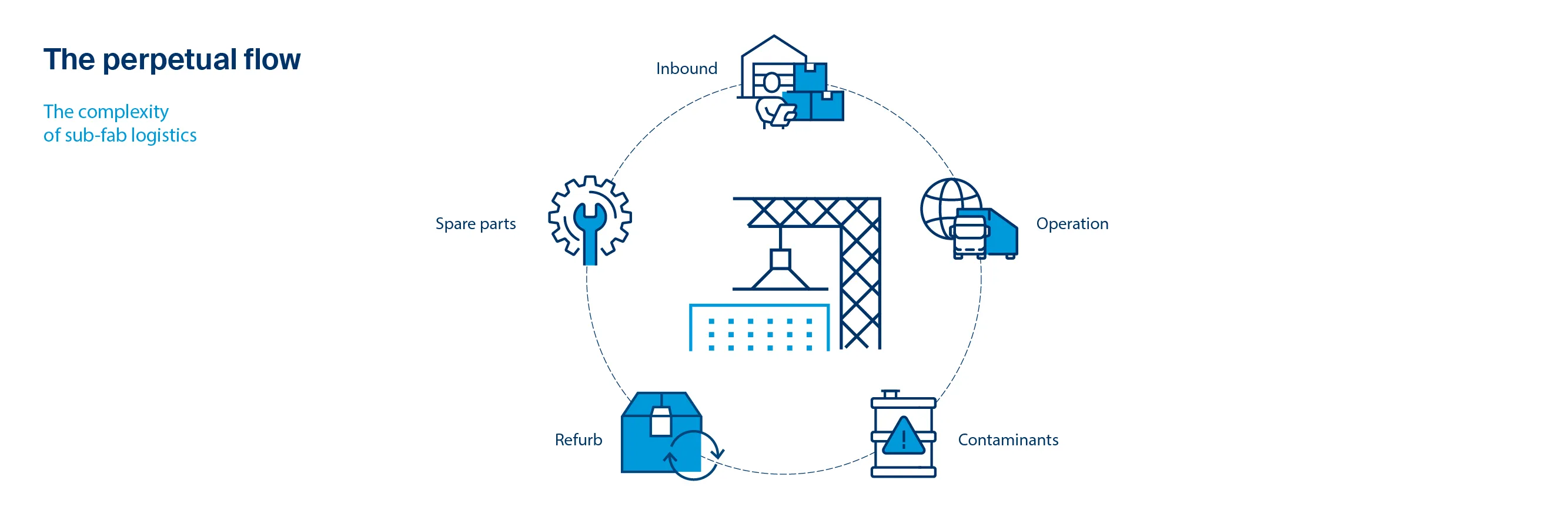
The lifecycle is the work
Here’s the part most conversations about logistics miss:
Cross-border, OOG, white-glove, time-boxed against fab ramp dates. Get this wrong, and you delay a node.
JIT and JIS spares, regulated materials, recurring flows of cylinders, scrubbers, filters, and consumables. A maintenance miscalculation can cause unplanned tool downtime in the fab. With every wasted second of productivity, the costs stack up. Time, in this case, really is money.
Equipment moves out of the fab into a refurbishment centre, and back. This often happens across borders and always under contamination and compliance constraints. Any mistakes can mean writing off equipment up to a decade before its expected lifespan.
Abatement system replacements, decommissioning, hazardous material disposition, asset recovery. Miscalculations here can result in you inheriting liability the fab can't afford.
These four phases are usually procured separately, by different teams, often through different vendors, against different KPIs. That is the structural mistake.
If these four stages of the lifecycle are treated as four logistics programmes, they will keep producing four logistics outcomes.
What this looks like on the ground
A well-known sub-fab supplier of equipment was in the process of installing new equipment for a new Wafer Fab tool.
To take advantage of the maintenance and install/commissioning wind-down, it was decided that older equipment would also be replaced. The older equipment was OOG. To avoid possible in-transit damage, the new equipment had to be shipped with specific tolerances.
Quarterly maintenance also had to be performed during the install. This meant that any movement and handling of equipment in and out of the sub-fab had to be done with minimum disruption and downtime.
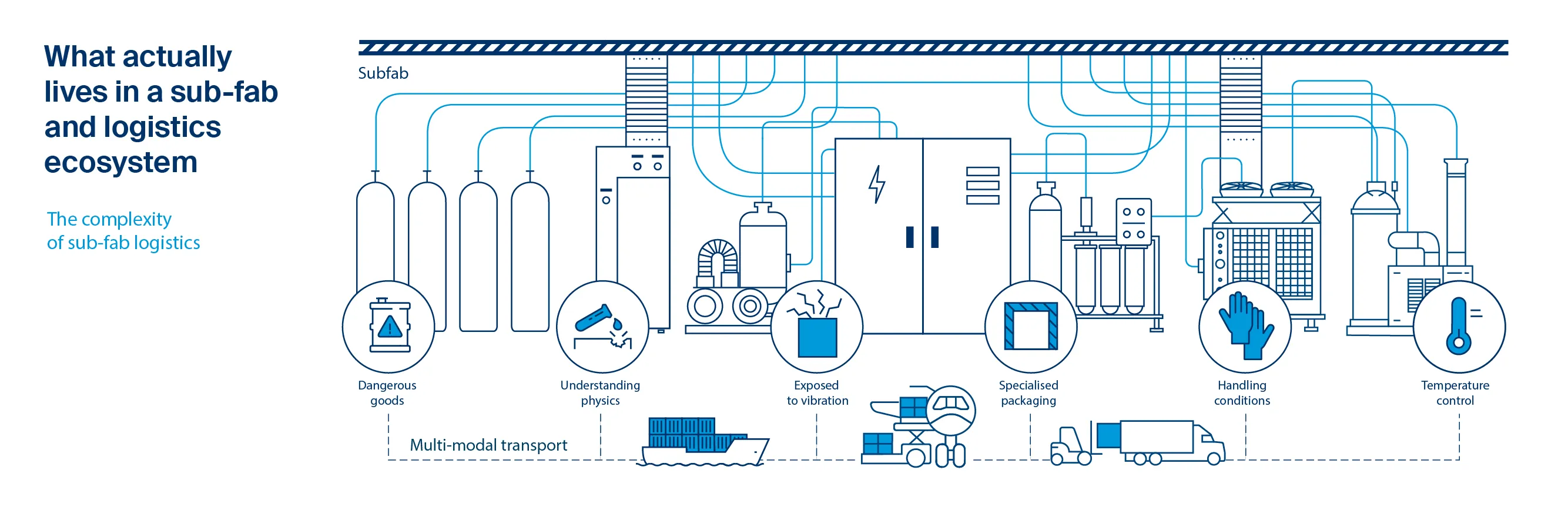
The “Swap” move and the return, repair, and refurbishment cycle involved moving equipment exposed to hazardous media. Special handling and containment methods were needed, which added to the overall complexity of the project.
From an outsider’s perspective, this complex logistics chain would involve multiple steps, partners and transport modes.
However, being able to provide a holistic, single-sourced solution resulted in a more manageable, traceable, trackable, and efficient plan.
What this means for fab operators
If you procure for the sub-fab, the implication is significant but actionable. You are likely procuring continuity through a logistics RFP, which means measuring freight outcomes when the real priority is operational continuity.
When continuity is the objective, the questions you have to ask must go beyond those typically addressed in a freight RFP.

It’s not simply "What is your rate per lane?". Instead, the questions should be:
Who has a single accountable view of my installation, maintenance, refurbishment, and reverse flow across the entire lifecycle?
Who can route regulated materials in and out of the same site under the same compliance regime?
Who can sequence forward and reverse flows, so refurbishment cycles don't fight my node ramp?
Who is accountable when an OOG shipment slips and a buildout date moves with it?
Why sub-fab logistics shouldn’t stay invisible?
The sub-fab is invisible to almost everyone who relies on it. That's fine. It's supposed to be.
But sub-fab logistics shouldn’t be invisible to the people who procure for them.
That's the mistake the industry has been making. It's a mistake that's getting more expensive every quarter as nodes get tighter, regulations get heavier, and regional expansion accelerates.
Stop looking at sub-fab logistics as just buying freight.
See it for what it really is: a critical component of fab continuity.
Only then can you take the right approach to resourcing it.
About the author
John Desmond has built a career spanning semiconductor manufacturing, electronics services, and logistics. Having worked across Fab, Sub-fab, and EMS environments, and with more than 15 years in logistics following a decade as a semiconductor engineer, he brings a unique perspective on supply chain challenges.
As Vice President, Global Cloud & Semiconductor Strategic Development at Kuehne+Nagel, John helps shape strategic supply chain solutions that enable resilience, scalability, and long-term growth for customers in these fast-evolving industries.

Discover related articles and services
Logistics determines whether a fab keeps running at full yield, whether a node ramps on schedule, whether a refurbishment cycle hits its window, and whether a CHIPS Act buildout finishes inside its political clock.
The terminology around sub-fab logistics isn’t the issue.
What matters is your mindset.
You can approach it like traditional logistics, focusing on fragmented, transactional, lowest-cost solutions. Or you can see it as a matter of continuity. That changes how you resource, procure and build partnerships around it.
This isn't a semantic argument. It's an operational one.
John Desmond
Vice President, Global Cloud & Semiconductor Strategic Development at Kuehne+Nagel